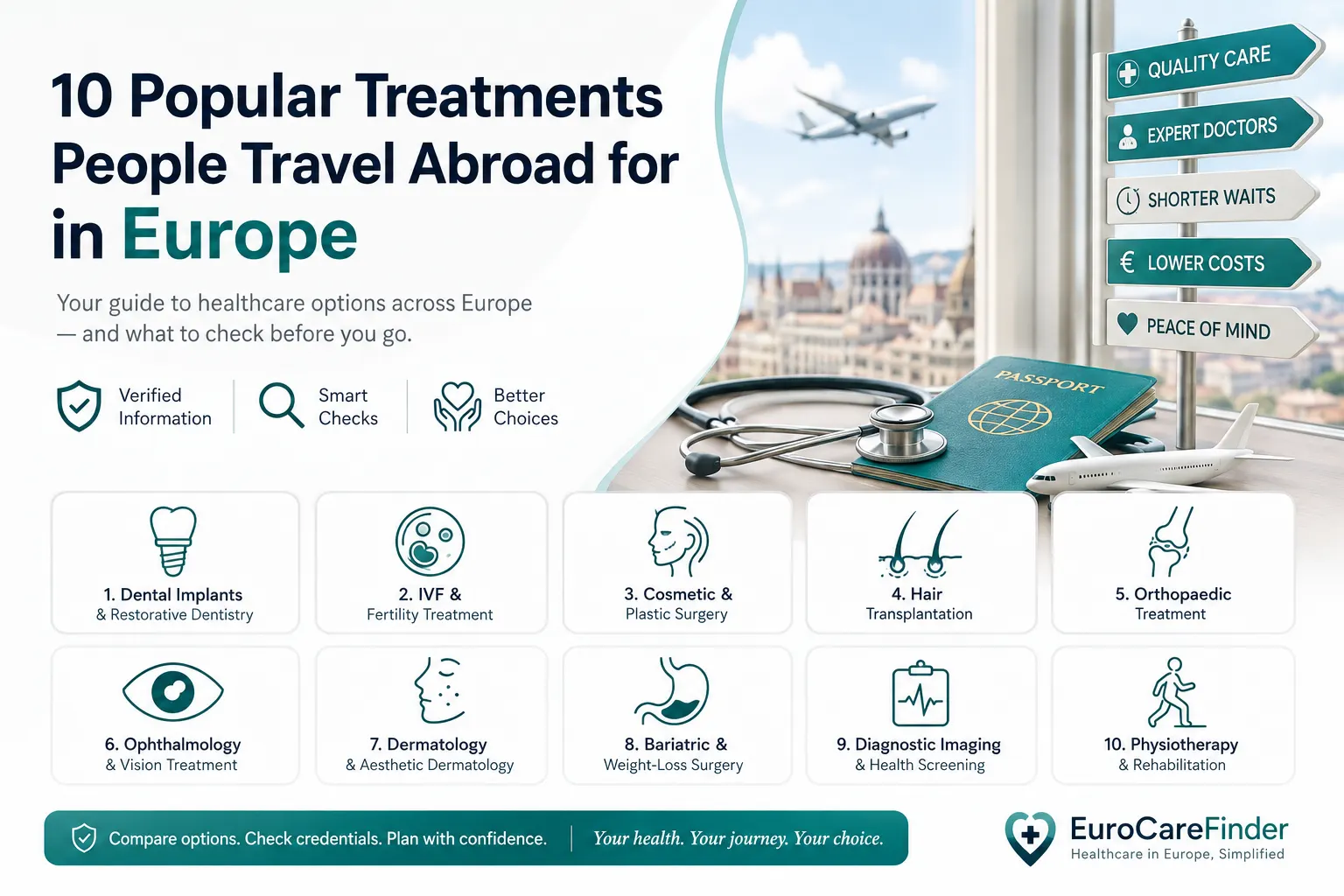
10 Popular Treatments People Travel Abroad for in Europe (2026 Guide)
Travelling abroad for healthcare is often associated with one thing: lower prices.
In reality, the reasons people cross borders for treatment are much broader.
Some patients are looking for shorter waiting times. Others want access to a particular specialist, treatment or fertility option. Some live close to another country's border, while others simply find that private treatment elsewhere in Europe offers a combination of price, availability and convenience that suits them better.
Cross-border healthcare is not a niche concept within Europe. EU rules provide mechanisms for patients to obtain planned healthcare in another EU country in certain circumstances, although the rules around reimbursement and prior authorisation can be complicated.
Interestingly, European Commission data suggests patient mobility is often between neighbouring countries, rather than always involving long-distance journeys to famous medical-tourism destinations.
So what treatments do people travel for?
There is no authoritative Europe-wide dataset that allows us to rank every procedure from most to least popular.
Instead, here are 10 prominent categories of treatment that patients may consider travelling abroad for, and the questions worth asking before booking.
1. Dental implants and restorative dentistry
Dentistry is one of the most visible areas of European medical tourism.
For patients requiring substantial restorative work, the difference between quotations from different countries can make travelling abroad attractive.
Treatments patients may investigate include:
- single dental implants
- multiple implants
- implant-supported bridges
- crowns and bridges
- dentures
- full-mouth rehabilitation
- veneers and other restorative or cosmetic dentistry
The attraction becomes particularly obvious when several teeth require treatment.
A relatively small difference in the price of one procedure can become a substantial difference when multiple implants, crowns or appointments are involved.
But headline prices deserve scrutiny.
A quotation for an implant, for example, may or may not include the implant itself, abutment, crown, scans, extraction, bone grafting, temporary restoration, medication and follow-up.
### Questions worth asking
Before travelling for dentistry, establish exactly which treatment is being proposed and what the quoted price includes.
Also consider how many trips will be necessary.
Some dental treatment requires healing between stages. A low initial quotation becomes less attractive if it requires several flights, hotels and periods away from work.
And ask what happens if something needs adjusting six months later.
The distance between patient and dentist matters much less when everything goes perfectly than when something needs attention.
2. IVF and fertility treatment
Fertility treatment is a particularly important form of cross-border healthcare because patients may travel for reasons extending far beyond price.
These can include:
- IVF
- ICSI
- donor eggs
- donor sperm
- embryo donation
- fertility preservation
- availability of donors
- waiting times
- different national eligibility rules
Fertility regulation differs considerably between countries.
The UK's Human Fertilisation and Embryology Authority advises patients considering overseas fertility treatment to investigate the country's laws, regulatory arrangements, clinic practices and treatment costs carefully.
Access for single women and same-sex couples, and rules surrounding donor treatment, can also vary between countries.
### Be careful with success rates
A fertility clinic advertising an impressive success rate deserves further investigation.
Success statistics can be presented in different ways and can be influenced by the characteristics of patients receiving treatment.
The HFEA advises caution when comparing overseas success claims because figures may, for example, relate to selected patient groups or pregnancies rather than births.
Ask what the statistic actually measures.
Donor treatment deserves additional research
Patients considering donor eggs, sperm or embryos should investigate:
- donor screening
- anonymity rules
- legal parenthood
- what information children may eventually access
- storage rules
- import and export requirements
- eligibility restrictions
These aren't small details.
They can have consequences long after the treatment itself.
---
3. Cosmetic and plastic surgery
Cosmetic surgery is probably one of the first things many people imagine when they hear the phrase medical tourism.
Procedures may include:
- breast augmentation
- breast reduction
- breast lift
- rhinoplasty
- abdominoplasty
- liposuction
- facelift
- eyelid surgery
- body-contouring procedures
Price differences can be substantial, particularly when clinics package surgery with accommodation and transfers.
But surgery is also an area where aftercare becomes particularly important.
The NHS advises patients considering cosmetic surgery abroad to research the surgeon's qualifications and experience, understand risks and complications, establish what follow-up is provided and investigate what happens if additional surgery becomes necessary.
Surgery is not a holiday
A package containing:
> surgery + hotel + airport transfer + sunshine
can make the experience look remarkably similar to booking a holiday.
It isn't.
Recovery may involve pain, medication, dressings, restrictions on activity and medical follow-up.
The NHS warns against treating the period immediately after surgery as a normal holiday.
Choose the healthcare first.
Consider the destination second.
4. Hair transplantation
Hair transplantation has become another highly visible area of international elective healthcare.
Patients may consider procedures such as:
- FUE hair transplantation
- FUT transplantation
- beard transplantation
- eyebrow transplantation
- corrective procedures following previous transplantation
The marketing surrounding hair transplantation can be extremely polished.
That makes one question particularly important:
> Who actually performs each stage of the procedure?
The person conducting your consultation may not necessarily perform every part of your treatment.
Before booking, ask who will design the hairline, extract grafts, create recipient sites and implant grafts, and what qualifications each person has.
### Don't judge solely from photographs
Before-and-after photographs can be useful, but they're still selected examples.
Ask whether the photographs show patients treated by the practitioner who will treat you and whether their hair characteristics and treatment are reasonably comparable with yours.
A clinic's best result isn't necessarily its typical result.
5. Orthopaedic treatment
Patients may also investigate travelling for musculoskeletal and orthopaedic care.
This broad category can include:
- specialist orthopaedic consultations
- arthroscopy
- knee procedures
- hip procedures
- joint replacement
- spinal assessment
- sports injury treatment
- post-operative rehabilitation
For major orthopaedic surgery, the initial procedure is only one part of the journey.
Rehabilitation can be equally important.
A patient considering treatment abroad should understand what happens after discharge and how physiotherapy and follow-up will continue after returning home.
Think beyond the operation
Ask:
- How long should I remain in the country?
- When can I travel safely?
- Who monitors my recovery at home?
- Who reviews scans or wound concerns?
- What happens if the implant or procedure needs investigation later?
A successful operation followed by fragmented aftercare is not an ideal treatment journey.
6. Ophthalmology and vision treatment
Eye care is another area in which patients may compare private providers across countries.
Procedures and services can include:
- laser vision correction
- cataract surgery
- lens replacement
- specialist ophthalmology consultations
- diagnostic eye examinations
For elective vision correction, patients should understand that suitability varies.
A treatment that worked well for somebody else does not automatically make it appropriate for you.
Ask about:
- pre-treatment assessment
- expected visual outcome
- limitations
- side effects
- alternative treatments
- follow-up schedule
- what happens if further correction becomes necessary
Be cautious about providers that appear to decide you are suitable for a procedure before conducting an adequate assessment.
7. Dermatology and aesthetic dermatology
Patients may travel for both medical and aesthetic skin treatments.
These can include:
- specialist dermatology consultations
- acne treatment
- scar treatment
- mole and lesion assessment
- laser treatments
- pigmentation treatment
- aesthetic dermatology
- selected injectable or rejuvenation procedures
There is an important distinction here.
Medical dermatology and cosmetic skin treatment aren't interchangeable.
A suspicious skin lesion, for example, should not be approached in the same way as an elective aesthetic concern.
For anything potentially requiring diagnosis, pathology or ongoing medical management, understand who will review test results and how those results will reach you after you've returned home.
8. Bariatric and weight-loss surgery
Bariatric surgery can involve procedures such as:
- sleeve gastrectomy
- gastric bypass
- revision surgery
- other specialist weight-management procedures
This is another category where comparing the operation price alone can be misleading.
Bariatric treatment can involve longer-term:
- nutritional monitoring
- dietary support
- blood tests
- supplementation
- medication review
- psychological support
- follow-up
That makes continuity of care particularly important.
Before travelling, patients should understand exactly what aftercare the overseas provider supplies and what healthcare support will be available after returning home.
The question shouldn't simply be:
> How much is the operation?
It should also be:
> What does my care look like six months after the operation?
9. Diagnostic imaging and health screening
Not every medical trip involves surgery.
Patients may also travel for:
- MRI
- CT imaging
- ultrasound
- private health screening
- blood testing
- specialist diagnostics
- executive health assessments
- second opinions
For some people, rapid access can be as important as price.
But diagnostic testing creates another question:
> What happens when the test finds something?
A scan is not useful simply because it can be obtained quickly.
Before undergoing testing, understand:
- who interprets the result
- what qualifications they hold
- when you'll receive the report
- whether images can be supplied digitally
- whether your home clinician can access them
- what happens if an urgent abnormality is identified
- whether further testing might be necessary
The value lies in the clinical pathway, not merely the scan.
10. Physiotherapy and rehabilitation
Rehabilitation can sometimes be particularly suited to longer stays abroad.
Patients may investigate:
- physiotherapy
- sports rehabilitation
- post-operative rehabilitation
- neurological rehabilitation
- musculoskeletal rehabilitation
- hydrotherapy
- multidisciplinary recovery programmes
Unlike a single procedure, rehabilitation may involve repeated sessions over days or weeks.
That means patients should compare the entire programme, not merely the cost of an individual appointment.
Ask:
- How many sessions are included?
- Who conducts them?
- Is the programme individual or group-based?
- Is progress formally assessed?
- Is there medical oversight where appropriate?
- Will I receive a rehabilitation plan to continue at home?
A good rehabilitation programme should ideally help bridge the transition back to your normal healthcare and daily life.
Why do people travel abroad for treatment?
There isn't one universal reason.
Cost
Private treatment prices differ between countries.
Labour costs, facility costs, taxation, insurance, medical-device pricing and local market conditions can all influence what a clinic charges.
For someone paying privately, those differences can matter.
Waiting times
Some patients investigate private treatment abroad because they don't want to wait for treatment at home.
Availability
A treatment, technique or specialist may be easier to access elsewhere.
Fertility treatment demonstrates this particularly well because national laws and eligibility rules can differ substantially.
Specialist expertise
Sometimes the attraction isn't the country.
It's a particular clinician or centre.
Geography
Cross-border healthcare doesn't always mean flying thousands of kilometres.
The European Commission's latest reporting says patient mobility under the EU cross-border healthcare framework occurs predominantly between neighbouring countries.
For somebody living near a national border, another country's hospital may not be particularly far away at all.
Which European country is cheapest for medical treatment?
This is one of the most tempting questions to answer — and one of the easiest to answer badly.
There is no single "cheapest country for healthcare in Europe."
A country that is inexpensive for dentistry may not be inexpensive for IVF.
Two clinics five kilometres apart can quote very different prices.
And two apparently identical procedures may include completely different things.
Instead of comparing:
> Country A: €3,000
> Country B: €4,000
compare the complete treatment package.
That might include:
| Cost | Remember to include |
| Treatment | Procedure and clinician fees |
| Diagnostics | Blood tests, imaging, scans |
| Anaesthesia | If applicable |
| Devices | Implants, lenses, prostheses etc. |
| Medication | Before and after treatment |
| Accommodation | Including additional recovery days |
| Travel | Flights, trains and transfers |
| Follow-up | Routine appointments |
| Return visits | If treatment requires multiple stages |
| Complications | What isn't included in the original price |
| Time away | Lost earnings or annual leave where relevant |
| Insurance | Appropriate cover for the trip |
The NHS advises patients travelling abroad for treatment to factor in exchange rates, extended stays and possible return trips when calculating costs.
The HFEA gives similar advice for fertility treatment: an attractive IVF headline price may exclude medication, blood tests or consultations, while flights, accommodation, insurance and time away from work can materially alter the real cost.
The cheapest quote may not be the cheapest treatment
Imagine:
Clinic A
- Treatment: €3,000
- Two journeys required
- Limited follow-up
Clinic B
- Treatment: €3,800
- One journey
- Follow-up included
Clinic A isn't necessarily cheaper once the entire journey is calculated.
That's why patients should compare the total treatment journey, rather than headline prices alone.
Can you use EHIC or GHIC for planned treatment abroad?
This needs some nuance.
An EHIC or UK GHIC should not be treated as medical-tourism insurance.
These cards are principally designed to provide access to medically necessary state healthcare during eligible temporary stays, and they don't replace travel insurance.
They also shouldn't be assumed to cover privately arranged planned treatment.
Separately, there are formal mechanisms through which eligible patients may arrange planned treatment elsewhere in Europe and potentially receive funding or reimbursement.
Those arrangements have specific rules and may require prior authorisation.
If you're deliberately travelling abroad for treatment, establish which scheme, if any, applies to you before travelling.
Do not assume presenting an EHIC or GHIC turns privately arranged medical tourism into funded treatment.
What about travel insurance?
Ordinary travel insurance may not cover planned medical treatment.
The NHS advises patients travelling for treatment to tell their insurer about their plans and obtain appropriate cover.
Check the policy carefully.
You may need to consider:
- treatment-related complications
- unrelated medical emergencies
- extended stays
- flight changes
- emergency transport
- repatriation
- pre-existing conditions
Emergency medical treatment and transport abroad can result in substantial costs without appropriate insurance.
How to choose a clinic abroad
Price comparison should come after basic safety checks.
Before paying a significant deposit, establish:
1. Who will actually treat you?
Get their full name.
2. Are they appropriately registered?
Where possible, verify their professional registration independently.
3. Is the provider authorised?
Within the EU, National Contact Points can provide information about healthcare systems and whether particular providers are registered and authorised to provide specific treatments.
4. What exactly is included?
Get the treatment plan and quotation in writing.
5. What are the important risks?
You should understand complications and alternatives, not merely expected benefits.
6. What happens afterwards?
Establish the follow-up arrangements before treatment.
7. What happens if something goes wrong?
Know who to contact and what additional treatment could cost.
8. Are you being pressured?
Hard selling, lack of information, pressure to decide quickly, failure to discuss complications and unclear aftercare arrangements should all prompt further questions.
Useful official resources
Patients considering planned treatment in another EU country can consult Your Europe for information about cross-border healthcare rights, reimbursement and National Contact Points.
The European Commission publishes information and data relating to cross-border healthcare within Europe.
UK patients considering treatment abroad can consult the NHS treatment abroad checklist and NHS guidance covering cosmetic surgery abroad.
Patients considering fertility treatment overseas can consult the Human Fertilisation and Embryology Authority (HFEA) for guidance on overseas fertility treatment, regulation, donor treatment, success rates and costs.
UK travellers should also check current GOV.UK guidance concerning travel insurance and healthcare abroad.
Medical disclaimer
This guide provides general information about treatments for which patients may consider travelling abroad. It does not constitute medical, legal, financial or insurance advice and does not recommend any particular treatment, clinic, healthcare professional or country.
Treatment suitability, regulation, professional qualifications, costs and patients' rights vary between countries and individuals.
Always seek advice from appropriately qualified healthcare professionals and verify current information with relevant national authorities, regulators, insurers and healthcare providers before arranging treatment abroad.

About the contributor
EuroCareFinder
Community Contributor
This contributor publishes information and discussion for the EuroCareFinder Community.