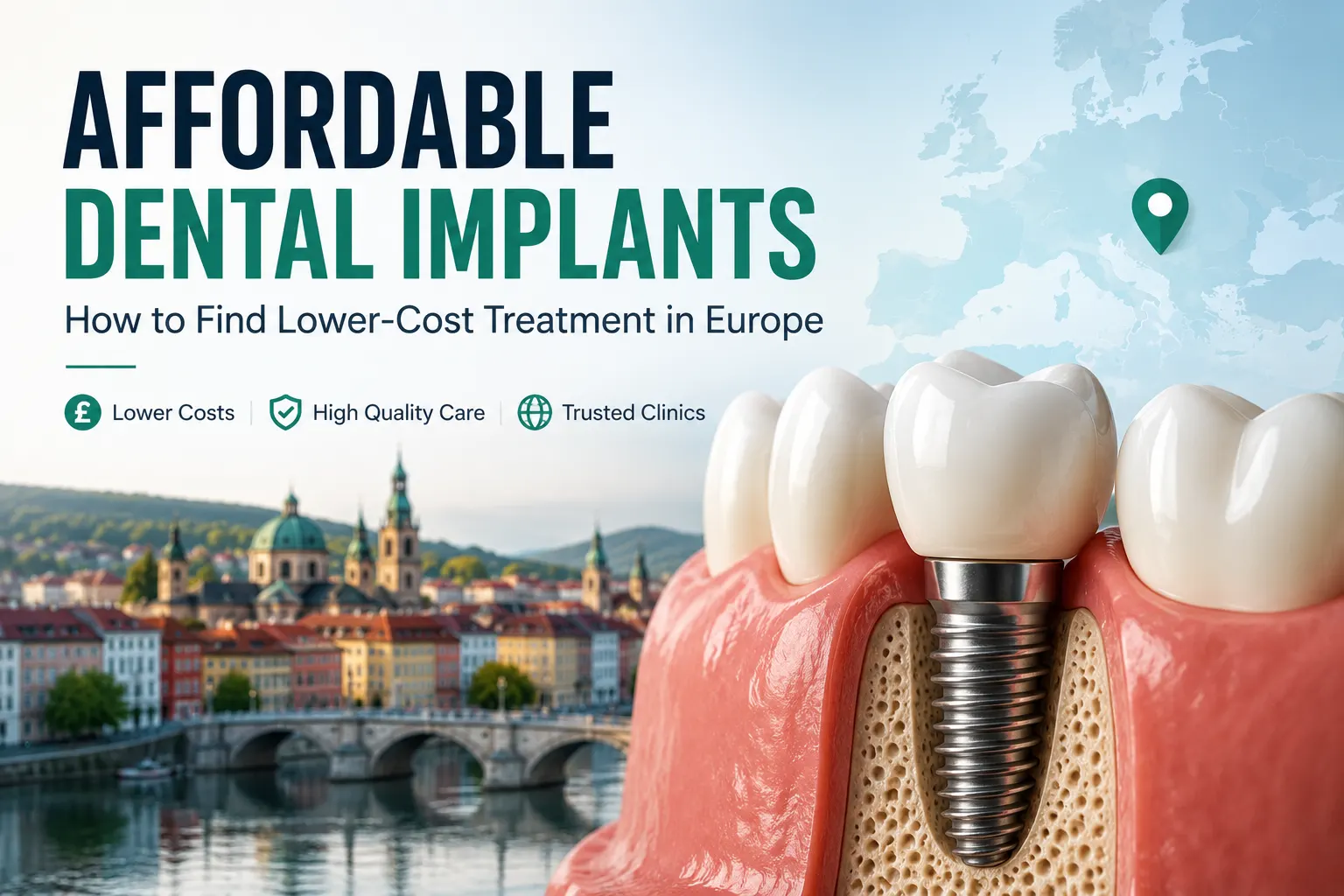
Dental implants can be an effective long-term option for replacing missing teeth — but the price can make them feel out of reach.
In the UK, dental implants are usually provided privately rather than through the NHS. That has led some patients to investigate whether they can find affordable dental implants elsewhere in Europe.
And price differences between clinics and countries can certainly exist.
But the cheapest quote isn't necessarily the cheapest treatment in the long run.
Implant treatment can involve assessment, surgery, healing, restorative work and follow-up appointments. If you're considering travelling for treatment, the real question isn't simply:
“Where can I get the cheapest dental implants?”
It's:
“Where can I find appropriately qualified care at a price I can afford, with a treatment and aftercare plan I understand?”
Here's what to consider.
What is a dental implant?
A dental implant replaces the root of a missing tooth.
The implant itself is typically a titanium screw placed into the jawbone. It can then support a crown, bridge or denture depending on how many teeth need replacing.
Implants can be used to replace:
A single missing tooth
Several missing teeth
Multiple teeth using an implant-supported bridge
A full arch of teeth
Dentures that need additional stability
Unlike some conventional bridges, an implant can replace a missing tooth without requiring neighbouring healthy teeth to be cut down for support.
However, implant treatment involves surgery and isn't appropriate for everyone.
Why are dental implants expensive?
When someone receives a quote for dental implants, it's easy to assume they're simply paying for a small titanium screw.
The reality is much more complicated.
The total cost can include:
Dental examinations
X-rays and 3D imaging
Treatment planning
Implant components
Implant surgery
Anaesthesia
Temporary teeth where required
Abutments
Crowns, bridges or dentures
Laboratory work
Follow-up appointments
Treatment of existing dental problems
Some patients also require additional procedures before an implant can be placed.
For example, insufficient bone may mean bone grafting is required, while implants in parts of the upper jaw can sometimes require sinus-related grafting procedures.
These additional treatments increase both the cost and complexity of treatment.
Why can dental implants be cheaper in Europe?
The same medical device doesn't necessarily cost the same amount to provide in every country.
Dental clinics operate within very different economies.
Staff costs, commercial rents, laboratory expenses, taxation and general operating costs can vary significantly between countries — and sometimes between cities within the same country.
That can allow some European clinics to offer dental treatment at prices below those commonly charged by private clinics in the UK.
This doesn't automatically mean the treatment is inferior.
It also doesn't automatically mean it's equivalent.
Country alone tells you very little about the quality of an individual clinic or dentist.
Two clinics located a few streets apart can have completely different clinicians, equipment, experience, treatment protocols and aftercare arrangements.
That's why comparing clinics matters more than simply identifying the cheapest country.
Looking for affordable European dental clinics?
If you're considering dental treatment abroad, EuroCareFinder can help you discover clinics across Europe and compare your options.
[BUTTON: Find Affordable European Clinics →]
Link the button to:
https://www.eurocarefinder.co.uk/
You can then research individual clinics, locations and available treatments before contacting a provider directly.
What affects the cost of dental implants?
There isn't one universal price for a dental implant.
Several factors can change the final cost substantially.
Number of implants
Replacing one tooth is very different from restoring an entire arch.
Someone requiring several implants will naturally face a larger overall treatment cost.
However, replacing every missing tooth doesn't necessarily mean placing one implant for every tooth.
Implants can sometimes support bridges or dentures, depending on the patient's clinical circumstances.
Implant system
There are numerous dental implant manufacturers and systems.
Ask the clinic exactly which implant system it intends to use.
This information can become particularly important years later if another dentist needs to identify, maintain or replace components.
Crown or bridge material
The visible restoration attached to the implant also contributes to the overall price.
Different materials and laboratory techniques can affect both cost and treatment planning.
Diagnostic imaging
Detailed assessment is an important part of implant planning.
Depending on the case, this may include conventional dental X-rays and three-dimensional imaging such as cone beam CT.
Bone grafting
There needs to be sufficient suitable bone to support an implant.
Where this isn't available, additional grafting procedures may be recommended.
That can add appointments, healing time and cost.
Additional dental treatment
Gum disease, active decay or other dental problems may need addressing before implant treatment proceeds.
Temporary teeth
If temporary restorations are required while treatment progresses, establish whether they're included in the advertised price.
Sedation
Patients requiring additional sedation may face further charges.
Aftercare
Perhaps most importantly, ask what happens after the implant has been placed.
A very cheap initial quote becomes considerably less attractive if every follow-up appointment costs extra.
Affordable doesn't have to mean cheapest
This distinction matters.
Imagine Clinic A quotes significantly less than Clinic B.
Clinic A's price doesn't include:
3D imaging
Temporary teeth
Bone grafting
Follow-up appointments
The final restoration
Clinic B provides one clearly itemised treatment plan covering most of those things.
Clinic A initially appears cheaper.
It might not be.
Before comparing prices, ask each clinic for a written, itemised treatment plan.
You want to understand what you're actually buying.
Questions to ask before comparing dental implant prices
Before choosing a clinic, ask:
Who will perform my implant surgery?
Find out the clinician's name, qualifications and relevant implant experience.
Which implant system will be used?
Keep a permanent record of the manufacturer and implant components used.
Is the final crown or bridge included?
Don't assume that an advertised implant price includes the finished tooth.
Are scans included?
Ask whether X-rays and any required 3D imaging are included.
What happens if I need bone grafting?
Ask what additional procedures might be necessary and what they would cost.
How many visits will I need?
Implant treatment may require multiple appointments over a period of months.
What happens if something goes wrong after I return home?
This is particularly important when travelling abroad.
Who provides long-term maintenance?
Dental implants still require ongoing oral hygiene and professional dental care.
Is it safe to get dental implants abroad?
There isn't a simple yes-or-no answer.
Good and poor dental care can exist in any country.
What matters is the specific clinic, clinician, treatment plan and regulatory environment you're dealing with.
If you're considering treatment abroad, investigate:
The dentist's professional registration
Qualifications and implant experience
Clinic accreditation where applicable
Which implant system will be used
Infection-control procedures
Diagnostic and treatment-planning process
How complications are handled
What aftercare is provided
How long you should remain in the country
What happens if further treatment is required after returning home
UK NHS guidance specifically advises patients considering medical treatment abroad to investigate the qualifications of the medical team and the standards of the facility, and to make sure possible complications and aftercare are discussed before booking.
Be particularly cautious if you encounter:
Pressure to pay immediately
Aggressive sales tactics
Very limited information about the clinician
Guarantees that sound unrealistic
No discussion of risks
No discussion of aftercare
A treatment plan produced without adequate clinical assessment
A lower price should never require you to stop asking questions.
Don't choose a dental clinic because you like the holiday destination
This is one of the easiest mistakes to make with dental tourism.
Beautiful beaches and inexpensive flights don't tell you anything about dentistry.
If you're travelling primarily for treatment, the clinical decision should come first.
Choose the clinician and clinic based on the treatment being offered, professional credentials, communication, facilities, treatment planning and aftercare.
Then think about the destination.
In fact, NHS guidance specifically recommends basing decisions about treatment abroad on the quality of medical care rather than how appealing the destination is for a holiday.
What is the real cost of dental implants abroad?
The clinic's treatment quote is only one part of the calculation.
Your actual cost could include:
Dental treatment
plus
Flights
plus
Accommodation
plus
Local transport
plus
Food
plus
Specialist insurance
plus potentially
A second trip
Implant treatment frequently involves multiple stages.
Don't assume you'll fly somewhere on Friday, receive your entire implant treatment on Saturday and return home on Sunday with everything permanently finished.
Depending on your clinical circumstances, healing may need to take place before the final restoration is fitted.
Ask the clinic for the expected timeline before booking flights.
What about “same-day” dental implants?
You may see clinics advertising concepts such as:
Same-day implants
Teeth in a day
Immediate-load implants
These terms don't necessarily mean every stage of treatment is permanently completed within 24 hours.
In appropriate patients, implants may sometimes be placed and fitted with a temporary restoration relatively quickly.
But suitability depends on individual clinical factors.
Ask exactly what is being fitted on the day of surgery and whether another restoration will be fitted later.
Marketing terminology should never replace a proper clinical explanation.
What about full-mouth dental implants?
For patients missing many or all of their teeth, treatment can become considerably more complex.
Rather than replacing each tooth with an individual implant, a smaller number of implants may sometimes support a fixed bridge or removable prosthesis.
You may encounter terms such as:
Full-mouth dental implants
Full-arch implants
All-on-4
All-on-6
These aren't necessarily interchangeable treatments.
The number and position of implants, type of restoration and treatment approach depend on the individual patient.
This is also why full-mouth implant prices can vary enormously.
If you're comparing full-mouth treatment abroad, compare the entire proposed restoration, not merely the number printed in an advertisement.
Can everyone have dental implants?
No.
Suitability requires individual assessment.
Factors that can influence implant treatment include:
General health
Oral health
Gum health
Available jawbone
Smoking
Existing dental disease
Ability to maintain excellent oral hygiene
Certain medications or medical circumstances
Expectations about treatment
Assessment can include examination, X-rays and sometimes 3D imaging.
Some patients may need additional dental treatment before implant surgery can proceed.
What happens if dental implants abroad go wrong?
This is something you should consider before treatment rather than afterwards.
Ask the overseas clinic:
Who do I contact in an emergency?
Is there an emergency number?
What does your guarantee actually cover?
Who pays for corrective treatment?
Would I need to travel back?
How quickly could you see me?
What records will you provide?
Will you give me details of the implant system used?
You should also consider what support is available at home.
NHS England states that patients who develop acute problems after self-funded dental treatment, whether performed privately in the UK or abroad, can access NHS assessment and stabilisation where appropriate. However, definitive replacement or continuation of privately funded treatment isn't automatically provided by the NHS.
That's an important distinction.
Don't build your treatment plan around the assumption that the NHS will simply finish or replace private implant work if problems occur.
Does EHIC or GHIC cover planned dental treatment abroad?
Don't assume so.
The UK Global Health Insurance Card (GHIC) and European Health Insurance Card (EHIC) are intended for necessary state healthcare that becomes medically necessary during a trip.
They do not cover travelling abroad specifically to receive planned private medical treatment.
If you're travelling for dental treatment, investigate appropriate insurance and tell the insurer why you're travelling.
Standard travel insurance may not cover complications resulting from planned treatment.
How to find affordable dental implants without focusing only on price
A better approach is to compare value, not simply the lowest number.
Step 1: Understand what treatment you actually need
Get a professional dental assessment.
A bargain implant isn't a bargain if an implant wasn't the most appropriate treatment in the first place.
Step 2: Obtain itemised quotes
Ask clinics to separate:
Implant placement
Implant components
Imaging
Bone grafting if required
Temporary restorations
Final crowns or bridges
Sedation if required
Follow-up appointments
Step 3: Compare clinicians
Look beyond clinic photographs and marketing.
Research the clinician who will actually perform your treatment.
Step 4: Compare implant systems
Ask what manufacturer and components will be used.
Step 5: Compare aftercare
This becomes particularly important when comparing clinics in different countries.
Step 6: Calculate travel costs
Include the possibility that more than one trip may be necessary.
Step 7: Ask what happens if treatment changes
An online quote may change after examination or imaging reveals something unexpected.
Ask how this would be handled before travelling.
Should you travel abroad for cheaper dental implants?
For some patients, travelling may provide access to treatment at a price they consider more affordable.
For others, the convenience of receiving treatment close to home and having easier access to follow-up care may outweigh potential savings.
There isn't one correct answer.
Consider:
Potential price difference
against
Travel expenses
Number of visits
Clinical quality
Communication
Aftercare
Convenience
Risk of complications
and
Cost of returning if something needs attention
The goal shouldn't be finding the cheapest implant in Europe.
It should be finding treatment you understand, from an appropriately qualified professional, at a total cost you're comfortable with.
Looking for affordable dental implants in Europe?
EuroCareFinder helps patients discover clinics across Europe and explore treatment options in different destinations.
If you're researching dental implants abroad, use the directory as a starting point and then investigate individual providers carefully.
Find Affordable European Clinics →
The bottom line
Dental implants can replace one or more missing teeth and support crowns, bridges or dentures.
They're also complex dental treatment.
If cost is preventing you from considering implants, comparing providers and countries may reveal options at different price points.
But affordable dental implants shouldn't mean cutting corners on assessment, treatment planning or aftercare.
Compare the complete treatment.
Research the clinician.
Ask about the implant system.
Understand how many visits are required.
Calculate travel and accommodation.
Plan for aftercare.
And ask what happens if something doesn't go according to plan.
A cheap headline price gets your attention.
A clear treatment plan tells you what you're actually paying for.
Have you considered dental implants abroad?
Have you received implant quotes in the UK or elsewhere in Europe?
Would you travel abroad for a substantially lower price, or would you rather pay more to have the treatment closer to home?
Share your experience with the EuroCareFinder Community.

About the contributor
EuroCareFinder
Community Contributor
This contributor publishes information and discussion for the EuroCareFinder Community.