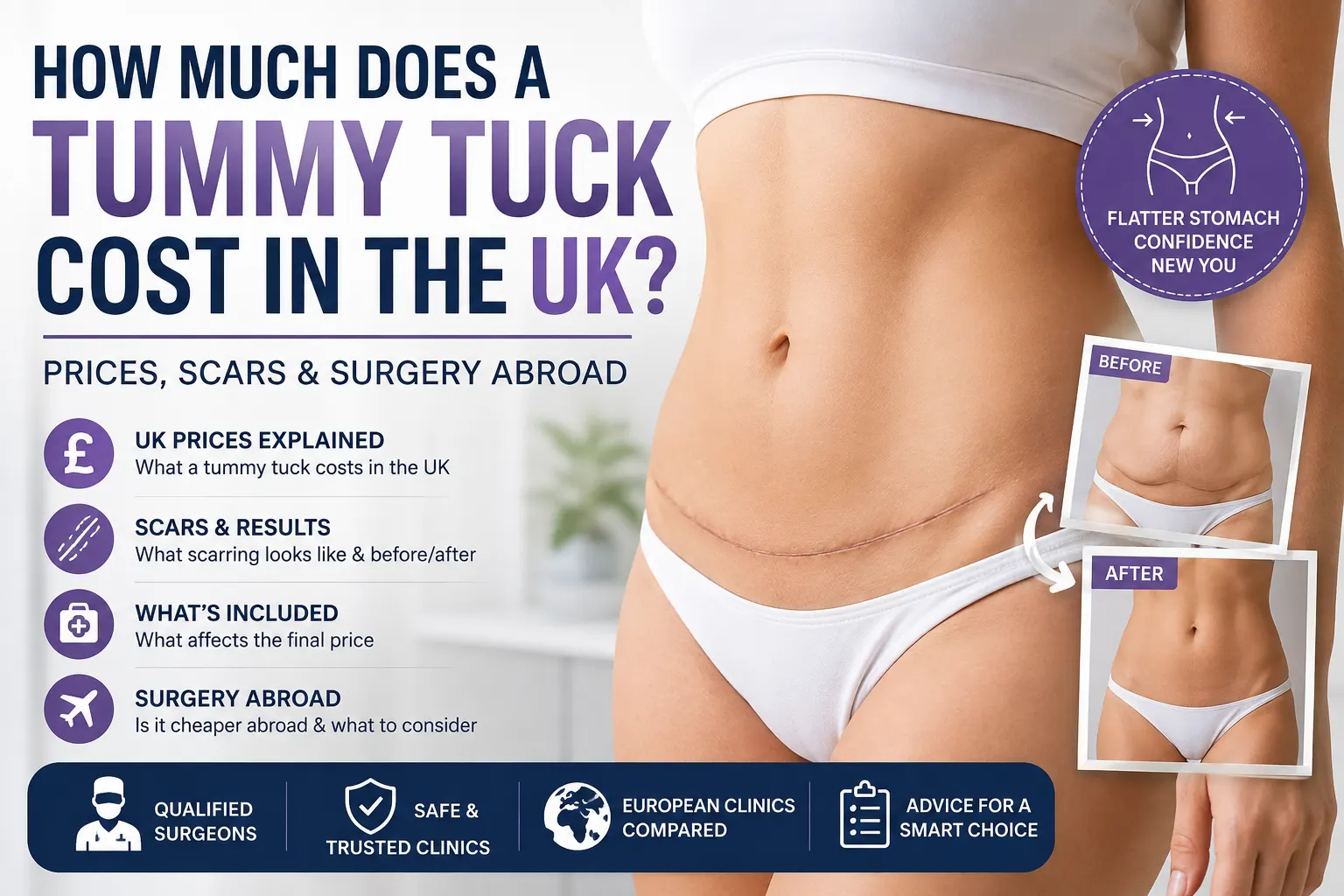
A tummy tuck can be one of the more expensive cosmetic procedures to research because there isn't one standard price.
The operation itself can vary considerably between patients. Some people need relatively limited removal of excess skin, while others may require a more extensive abdominoplasty involving skin and fat removal, repositioning of the belly button and tightening of separated abdominal muscles.
So if you're asking:
“How much does a tummy tuck cost in the UK?”
the short answer is that the NHS currently gives a typical private UK range of around £5,000 to £10,000, with consultation and follow-up costs potentially charged separately.
But the headline price is only the beginning.
What is a tummy tuck?
A tummy tuck — medically called abdominoplasty — is an operation designed to improve the shape of the abdomen.
It can involve removing loose skin and fat and, in some cases, tightening abdominal muscles that have separated.
People may consider the procedure after:
Pregnancy
Significant weight loss
Changes in body shape with age
Persistent loose abdominal skin
Previous abdominal surgery
The NHS emphasises that abdominoplasty is not a quick fix for weight loss and is generally intended for people at a healthy body weight.
BAPRAS describes abdominoplasty as a more extensive operation than a simple apronectomy, and notes that the precise surgical approach depends on where the excess tissue lies and whether the abdominal muscles also need attention.
How much does a tummy tuck cost in the UK?
The NHS currently states that an abdominoplasty in the UK can cost approximately:
£5,000 to £10,000
with additional charges potentially applying for consultations or follow-up care.
That broad range exists because no two tummy-tuck procedures are necessarily identical.
Your final quote may depend on:
The extent of excess skin
Whether fat removal is also required
Whether abdominal-muscle repair is needed
The complexity and duration of surgery
Surgeon fees
Anaesthetist fees
Hospital or theatre charges
Overnight stay
Compression garments
Follow-up appointments
Revision procedures if later required
This is why comparing only the advertised figure can be misleading.
What affects tummy tuck cost?
The type of procedure
A limited procedure and a full abdominoplasty are not the same operation.
BAPRAS describes an apronectomy as removal of excess hanging skin and fat from the lower abdomen, while an abdominoplasty can address a wider area and may also involve abdominal-muscle repair.
A more extensive operation generally requires more theatre time and clinical resources.
Surgeon experience
Fees can differ substantially between surgeons.
An experienced plastic surgeon with a large cosmetic-surgery practice may charge more than a less-established provider.
Price alone does not establish quality, but unusually low prices are worth investigating carefully.
Hospital and anaesthetic fees
A tummy tuck is major surgery and is usually performed under general anaesthetic.
BAPRAS says an abdominoplasty may take around three to four hours and commonly involves a hospital stay of one or two nights.
Those costs can be included in a package or itemised separately.
Muscle repair
Pregnancy and major weight changes can leave the abdominal muscles separated.
If the surgeon recommends repairing this separation, the procedure may become more complex.
Additional procedures
Some patients combine abdominoplasty with procedures such as liposuction.
That can increase cost, surgical time and risk.
Is a mini tummy tuck cheaper?
You may encounter the term mini tummy tuck.
This generally refers to a less extensive operation focused more heavily on the lower abdomen.
However, whether a smaller procedure is appropriate depends on your anatomy and what you are trying to achieve.
A cheaper operation isn't automatically the right operation.
The important question is whether the proposed surgery actually addresses the problem you want treated.
Is tummy tuck surgery available on the NHS?
Usually not.
Both the NHS and BAPRAS describe cosmetic abdominoplasty as treatment that is generally not routinely funded by the NHS, although exceptional circumstances may exist.
That means most people considering a tummy tuck will be looking at private treatment.
This is one reason price comparisons become so important.
What should a tummy tuck quote include?
Before comparing prices, ask for a written breakdown.
Find out whether your quote includes:
Surgeon fee
Is this the complete surgical fee?
Anaesthetist
Is anaesthesia included?
Hospital or theatre costs
Are facility charges included?
Overnight stay
Will you stay in hospital after surgery, and is this included?
Compression garments
Are post-operative garments supplied?
Medication
Are pain relief and other prescribed medicines included?
Follow-up appointments
How many reviews are covered?
Treatment of complications
What happens financially if you require further care?
Revision surgery
Is any revision policy offered?
Without this information, two prices cannot be meaningfully compared.
What does a tummy tuck scar look like?
Scarring is unavoidable.
A tummy tuck involves surgical incisions, and every surgical incision leaves a scar.
The exact scar pattern depends on the operation being performed.
BAPRAS notes that the scar may vary according to the location and amount of excess tissue being treated.
For a conventional abdominoplasty, the main scar usually runs across the lower abdomen.
There may also be a scar around the belly button depending on the technique.
The NHS says tummy-tuck scars may initially be raised, red or different from your normal skin colour and can take around 12 to 18 months to fade.
They do not completely disappear.
Can a tummy tuck remove stretch marks?
Sometimes — but not all of them.
If stretch marks are located on skin that is surgically removed, those marks may be removed with it.
Other stretch marks may remain.
BAAPS guidance explains that stretch marks can sometimes be cut away or tightened as part of abdominoplasty, but this depends on where they are located.
A surgeon should explain what is realistically achievable rather than promising perfectly smooth skin.
What are the risks of a tummy tuck?
A tummy tuck is major surgery, not a minor beauty treatment.
Potential complications listed by the NHS include:
Prominent scarring
Wound-healing problems
Fluid collections
Haematoma
Numbness
Pain
Breathing problems
Infection
Excessive bleeding
Blood clots
Anaesthetic reactions
BAPRAS also discusses risks including seroma, tissue loss, altered sensation, asymmetry and deep-vein thrombosis/pulmonary embolism in body-contouring surgery.
This is why choosing a properly qualified surgeon and understanding the aftercare plan matters so much.
How long does recovery take?
Recovery varies between individuals and according to the extent of surgery.
The NHS notes that after abdominoplasty it is common to experience:
Pain and bruising
Difficulty standing fully upright at first
Numbness
Temporary swelling
A pulling sensation across the abdomen
You should receive individual instructions about:
Time off work
Walking and mobility
Lifting
Driving
Exercise
Compression garments
Wound care
Do not build your recovery plan around someone else's social-media timeline.
Can you fly after a tummy tuck?
This becomes particularly important if you're considering surgery abroad.
The NHS specifically warns that both air travel and major surgery increase the risk of blood clots.
Its cosmetic-surgery-abroad guidance recommends avoiding flying for around 7 to 10 days after a tummy tuck.
Your surgeon may recommend a longer period depending on your health and procedure.
That means a cosmetic-surgery trip isn't simply:
Fly out → surgery → weekend away → fly home.
You need enough time to recover safely.
Tummy tuck abroad: why do people consider it?
Cost is one obvious reason.
Private cosmetic-surgery prices vary between countries, and some patients find lower headline prices outside the UK.
Others may look abroad because of:
Greater clinic choice
Shorter waiting times
Particular surgeons
Recommendations from friends or family
Availability of package arrangements
But lower advertised prices can come with additional costs and logistical complications.
Looking for tummy tuck clinics in Europe?
If you're considering cosmetic surgery elsewhere in Europe, EuroCareFinder can help you discover clinics and compare possible destinations.
[BUTTON: Find Cosmetic Surgery Clinics in Europe →]
Link to:
https://www.eurocarefinder.co.uk/
Use a clinic directory as the beginning of your research — not the end.
Always investigate the surgeon, clinic, regulation, aftercare and full treatment plan yourself.
Is a tummy tuck cheaper abroad?
It can be.
But the NHS specifically advises patients travelling for treatment to calculate the real total cost, including exchange rates, extended stays and possible return trips.
Your overseas treatment cost might involve:
Surgery
plus
Flights
plus
Accommodation
plus
Local transport
plus
Food
plus
Specialist insurance
plus potentially
Return flights for follow-up or complications
A £2,000 headline saving can shrink quickly if another trip becomes necessary.
Don't treat cosmetic surgery like a holiday package
This deserves its own section.
The NHS warns people to be cautious about cosmetic surgery marketed as part of a holiday and says it's unrealistic to treat the period immediately after surgery as a normal vacation.
After surgery you may need rest and clinical monitoring.
Activities such as:
Drinking alcohol
Sunbathing
Swimming
Extensive sightseeing
may be inappropriate during early recovery.
Choose the clinic because of the medical care, not because the hotel has a pool.
How do you compare tummy tuck clinics abroad?
Identify the surgeon
Ask who will actually perform your operation.
You should know their name before paying.
Check qualifications
Investigate the surgeon's training and professional registration in the country where they practise.
Ask about experience
How many abdominoplasties do they perform?
Have a proper consultation
The NHS advises patients considering cosmetic surgery abroad to have consultations directly with the surgeon rather than dealing only with sales staff.
Understand the proposed procedure
Ask exactly what type of abdominoplasty is being recommended and why.
Discuss risks
Complications should be explained clearly.
Understand aftercare
Where will follow-up appointments happen?
Know the complication policy
What happens if something goes wrong?
Red flags when choosing a tummy tuck clinic
Be cautious if you encounter:
Pressure to book immediately
Major surgery should not come with a countdown timer.
Huge “today only” discounts
Urgency is a sales technique, not a clinical indication.
No consultation with the surgeon
A salesperson cannot replace the person operating on you.
No discussion of complications
Every operation carries risk.
No clear aftercare
Recovery is part of the procedure.
Unrealistic promises
A surgeon should explain limitations as well as potential benefits.
Holiday-focused advertising
Beach photographs are not evidence of surgical quality.
The NHS treatment-abroad checklist specifically warns about hard selling, pressure to make quick decisions, poor information and lack of discussion around complications and aftercare.
What happens if something goes wrong abroad?
This is arguably one of the most important questions to ask.
The NHS notes that overseas clinics may not provide the same follow-up arrangements available after surgery in the UK.
Before travelling, ask:
Who do I contact if I develop a complication?
Is emergency support available?
Would I need to return to the original clinic?
Who pays for additional treatment?
Can I be reviewed remotely?
What happens if revision surgery is required?
Will I receive complete medical records?
These questions should be answered before money changes hands.
Does travel insurance cover cosmetic surgery abroad?
Don't assume it does.
Most ordinary travel insurance policies are not designed to cover planned medical treatment, and the NHS advises patients to tell insurers about their intention to undergo treatment abroad.
You may need specialist insurance.
Read the exclusions carefully.
UK tummy tuck vs surgery abroad
Neither option is automatically better.
Staying in the UK
Possible advantages include:
Easier pre-operative consultations
Easier follow-up
No flights immediately before or after surgery
Familiar regulatory environment
Easier access to the original surgeon if complications occur
Travelling abroad
Possible advantages can include:
Different price points
More clinic options
Access to particular surgeons
But additional considerations include:
Travel
Accommodation
Regulation
Language
Insurance
Follow-up
Returning home after major surgery
The correct comparison is not:
UK expensive / abroad cheap
It is:
complete treatment plan vs complete treatment plan.
How much does a tummy tuck really cost?
The real answer is:
More than the surgery fee alone.
Your total cost includes everything required to get safely from consultation through recovery.
For UK treatment, ask for a full written quote.
For overseas treatment, calculate:
Treatment + travel + accommodation + insurance + recovery time + potential return trips.
Then compare the complete package.
Should you choose the cheapest tummy tuck?
No — at least not because it's the cheapest.
Price matters.
For most people, thousands of pounds matter a great deal.
But this is major surgery.
A better objective is to find good value, meaning:
Appropriately qualified surgeon
Proper consultation
Suitable operation
Clear treatment plan
Transparent costs
Appropriate facility
Realistic expectations
Proper aftercare
Then compare price.
Questions to ask before booking a tummy tuck
Before committing to surgery, consider asking:
Are you a specialist plastic surgeon?
How many tummy tucks do you perform?
Which type of abdominoplasty do you recommend for me?
Why is that operation appropriate?
Will my abdominal muscles be repaired?
Where will my scars be?
What complications are possible?
What is your complication rate?
How long will I remain in hospital?
How much time should I take off work?
When can I exercise again?
If I'm travelling, when can I safely fly?
What aftercare is included?
What happens if I develop a problem?
What is the complete cost?
Good cosmetic surgery should survive detailed questions.
Find tummy tuck clinics in Europe
If you're comparing UK prices with treatment elsewhere in Europe, EuroCareFinder can help you discover cosmetic-surgery clinics in different destinations.
Explore European Cosmetic Surgery Clinics →
Research each provider carefully and discuss your individual circumstances directly with an appropriately qualified surgeon before making a treatment decision.
So, how much does a tummy tuck cost in the UK?
Current NHS guidance puts the typical private UK price at around £5,000 to £10,000, potentially plus consultation and follow-up costs.
But a meaningful quote depends on what you personally need.
The extent of surgery, muscle repair, hospital charges, surgeon fees and aftercare can all influence the final cost.
If you're considering treatment abroad, lower prices may be available.
But remember to include travel, accommodation, insurance, recovery and possible return visits.
And whichever country you choose, the most important question isn't:
“Where is the cheapest tummy tuck?”
It's:
“Who is operating on me, what exactly are they proposing, and what happens if something goes wrong?”
Would you have a tummy tuck abroad to save money?
Suppose a UK surgeon quoted £8,000 and an overseas clinic offered what appeared to be similar treatment for substantially less.
Would the saving persuade you to travel?
Or would you pay more to keep your surgeon and aftercare close to home?
If you've had abdominoplasty in the UK or elsewhere in Europe, share your experience with the EuroCareFinder Community.
Sources / further reading
NHS — Tummy tuck (abdominoplasty)
Procedure, UK cost range, recovery and complications.
BAPRAS — Abdominoplasty
Patient information about surgery, availability and surgical approaches.
NHS — Cosmetic surgery abroad
Guidance covering surgeon selection, aftercare, flying and complications.
NHS — Treatment abroad checklist
Guidance covering total costs, insurance, qualifications and warning signs.
Medical disclaimer: This article provides general information about abdominoplasty and treatment abroad. It is not medical advice and cannot determine whether surgery is appropriate for any individual. Anyone considering a tummy tuck should discuss their circumstances, risks and alternatives with an appropriately qualified healthcare professional.

About the contributor
EuroCareFinder
Community Contributor
This contributor publishes information and discussion for the EuroCareFinder Community.