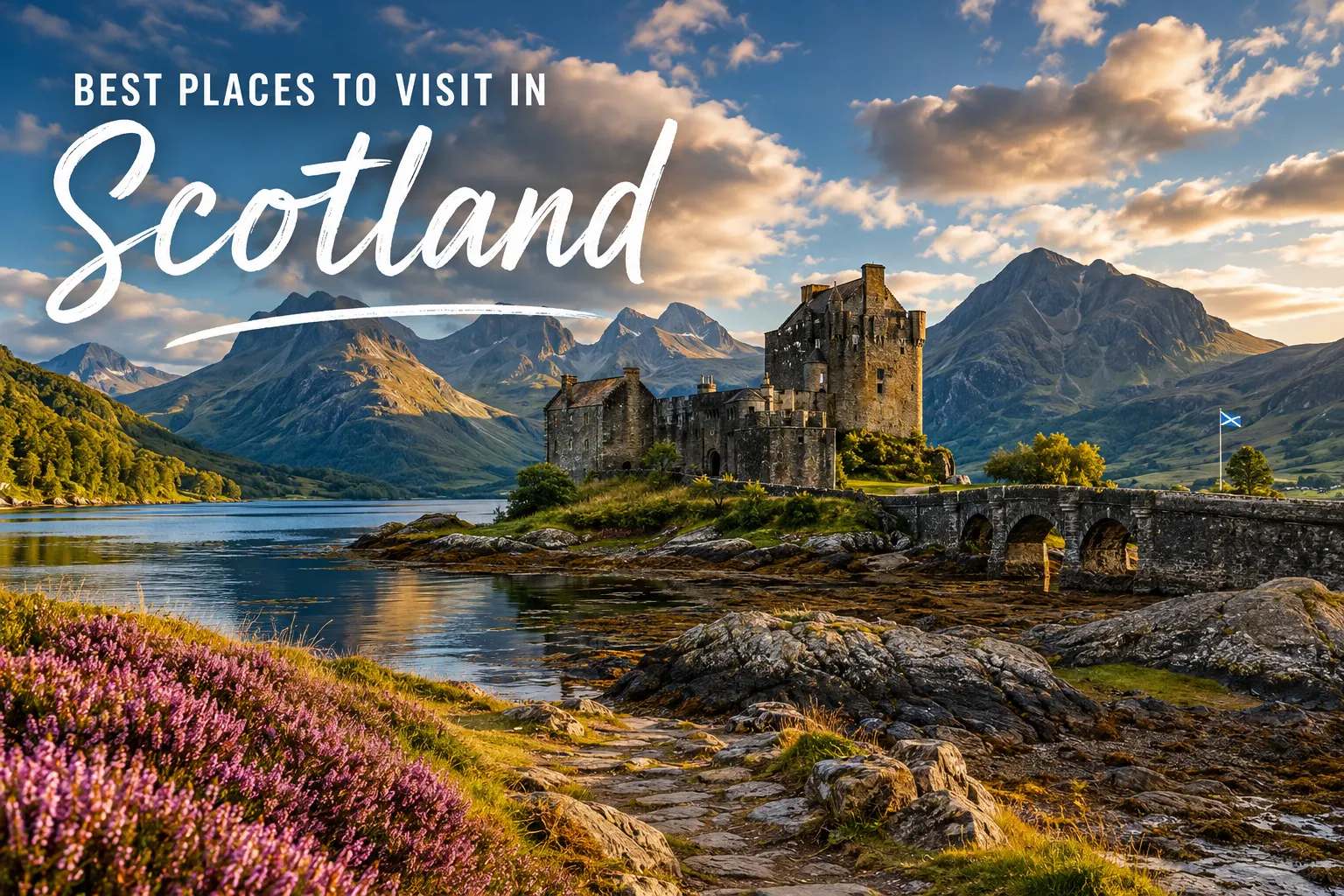
Scotland packs an extraordinary amount into a relatively small country.
Ancient cities give way to mountains, enormous lochs, isolated beaches, ruined castles and islands that can feel a world away from mainland Britain.
You can spend the morning walking through Edinburgh's medieval Old Town and, a few days later, find yourself standing beneath the mountains of Glencoe or watching the Atlantic crash against the coast of the Isle of Skye.
But with so much to choose from, where should you actually go?
If you're planning your first trip — or looking for somewhere new to explore — here are 15 of the best places to visit in Scotland.
1. Edinburgh
Best for: First-time visitors, history and city breaks
How long: 2–3 days
For a first visit to Scotland, Edinburgh is difficult to beat.
Scotland's capital combines dramatic architecture, centuries of history and an unusually walkable city centre.
Start in the Old Town and follow the Royal Mile between Edinburgh Castle and the Palace of Holyroodhouse.
Explore the narrow closes branching away from the main street, visit the National Museum of Scotland and climb Arthur's Seat if the weather cooperates.
Then cross into the Georgian New Town for a completely different side of Edinburgh.
The city becomes exceptionally busy during its famous summer festivals, while winter brings Christmas events and Hogmanay.
Edinburgh is also an excellent starting point for a longer Scottish trip, with straightforward connections towards Glasgow, Stirling and the Highlands.
Don't miss: The view across Edinburgh from Arthur's Seat.
2. Isle of Skye
Best for: Dramatic landscapes, hiking and photography
How long: 2–4 days
If you've ever seen photographs of Scotland that look almost unreal, there's a reasonable chance they were taken on Skye.
The island's landscape is extraordinary.
Jagged mountains rise behind green valleys, waterfalls tumble towards the sea and narrow roads twist through scenery that seems to change every few minutes.
Some of Skye's most famous sights lie around the Trotternish Peninsula.
Here you'll find the Old Man of Storr, Quiraing, Kilt Rock and Fairy Glen.
Elsewhere, the Fairy Pools and dramatic Cuillin mountains provide even more reasons to explore.
Portree, with its colourful harbourfront buildings, makes a popular base.
One warning: Skye's popularity means accommodation can disappear quickly during the busiest months.
Book ahead rather than assuming you'll find somewhere when you arrive.
Don't miss: The Quiraing on a clear morning.
3. Glencoe
Best for: Mountain scenery, hiking and road trips
How long: 1–2 days
There are places where pulling the car over becomes almost compulsory.
Glencoe is one of them.
The deep Highland valley was shaped by ancient glaciers and volcanic activity, leaving behind some of Scotland's most recognisable mountain scenery.
The road through the glen provides extraordinary views even if you never put on hiking boots.
But walkers have considerably more to explore.
The Three Sisters of Glencoe dominate one of the area's most famous viewpoints, while numerous trails lead deeper into the surrounding landscape.
Glencoe also carries a darker history.
The 1692 Glencoe Massacre remains one of the most infamous episodes in Scottish history, adding another dimension to an area already defined by its landscape.
Don't miss: Driving through the glen early in the morning before the roads become busier.
4. Loch Lomond & The Trossachs
Best for: Lochs, walking and an easy escape from Glasgow
How long: 1–3 days
You don't have to travel to Scotland's far north to find spectacular scenery.
Loch Lomond & The Trossachs National Park sits conveniently north of Glasgow and contains 22 lochs, 21 Munros and enormous areas of countryside.
Loch Lomond itself is the largest loch in Scotland by surface area.
Visitors can cruise across the water, walk sections of the West Highland Way, climb Conic Hill or simply explore small communities around the shoreline.
The village of Luss is particularly popular, while Balloch provides one of the easiest entry points from Glasgow.
If you're visiting Scotland for only a few days and don't have time to travel deep into the Highlands, Loch Lomond provides an excellent taste of the landscape.
Don't miss: The view over Loch Lomond from Conic Hill.
5. Cairngorms National Park
Best for: Mountains, wildlife and outdoor adventures
How long: 2–4 days
The Cairngorms are Scotland on an enormous scale.
Britain's largest national park stretches across 4,528 square kilometres and contains five of the UK's six highest mountains.
But mountains are only part of the attraction.
The park contains forests, rivers, lochs, wildlife habitats, castles, distilleries and Highland communities.
Aviemore makes a convenient base for exploring the northern Cairngorms.
From there, visitors can hike, cycle, explore Rothiemurchus Forest or visit beautiful Loch Morlich.
Winter transforms parts of the park again, bringing opportunities for snow sports when conditions allow.
If your idea of Scotland involves disappearing into enormous landscapes rather than spending your trip moving between cities, put the Cairngorms near the top of your list.
Don't miss: Loch Morlich with the Cairngorm mountains rising behind it.
6. Loch Ness & Inverness
Best for: Highland history, castles and legendary monsters
How long: 1–2 days
Let's deal with the obvious question first.
Will you see Nessie?
Probably not.
Should you visit anyway?
Absolutely.
Loch Ness is surrounded by beautiful Highland scenery and makes an easy excursion from Inverness.
One of the best places to experience the loch is Urquhart Castle, whose ruins sit dramatically beside the water.
Boat trips provide another perspective and, naturally, numerous attractions around the area explore the legend of the Loch Ness Monster.
Nearby Inverness is known as the capital of the Highlands and makes a useful base for exploring northern Scotland.
History enthusiasts should also consider Culloden Battlefield, where the final battle of the Jacobite Rising took place in 1746.
Don't miss: Urquhart Castle overlooking Loch Ness.
7. St Andrews
Best for: History, coastal scenery and golf
How long: 1 day or a weekend
St Andrews is internationally famous as the home of golf.
But you don't need to know the difference between a birdie and a bogey to enjoy it.
The compact university town has medieval streets, beaches, historic university buildings and impressive ruins.
St Andrews Cathedral was once Scotland's largest cathedral, while nearby St Andrews Castle occupies a dramatic position above the sea.
Then, of course, there's the Old Course.
Golfers travel from around the world simply to stand here.
St Andrews works particularly well as a day trip from Edinburgh, although staying overnight gives you more time to explore the surrounding Fife coast.
Don't miss: Walking beside the Old Course towards West Sands Beach.
8. Glasgow
Best for: Music, food, museums and nightlife
How long: 2 days
Edinburgh usually receives more attention from international visitors.
Glasgow deserves considerably more than being treated as the city you fly into before leaving for somewhere else.
Scotland's largest city has an excellent music scene, impressive Victorian architecture, major museums and some of the country's liveliest nightlife.
Kelvingrove Art Gallery and Museum is an obvious starting point.
Explore the West End afterwards, walk through the University of Glasgow grounds and spend some time around Ashton Lane.
Glasgow also works extremely well as a gateway to western Scotland.
Loch Lomond is close enough for a day trip, while trains and roads continue towards Oban, Glencoe and the Highlands.
Don't miss: An evening exploring Glasgow's live music scene.
9. Orkney
Best for: Archaeology, ancient history and remote landscapes
How long: 3–5 days
Orkney changes your sense of time.
The islands contain archaeological sites that were ancient long before many of Europe's most famous monuments existed.
The Heart of Neolithic Orkney is UNESCO-listed and includes Skara Brae, the Ring of Brodgar, Standing Stones of Stenness and Maeshowe.
Skara Brae is particularly remarkable.
The prehistoric settlement provides an extraordinary glimpse into everyday life thousands of years ago.
But Orkney isn't simply an archaeological trip.
The islands contain dramatic cliffs, beaches, wildlife and traces of both Norse and more recent wartime history.
Getting there takes more effort than visiting Edinburgh or Loch Lomond.
That's part of the appeal.
Don't miss: Standing among the Ring of Brodgar as the weather rolls across the landscape.
10. Fort William & Ben Nevis
Best for: Hiking and outdoor adventure
How long: 2–3 days
Fort William sits beneath Britain's highest mountain.
That alone makes it one of Scotland's major outdoor destinations.
Experienced and properly prepared walkers come to climb Ben Nevis, while the wider Lochaber region offers hiking, cycling and spectacular Highland scenery.
You don't have to climb the mountain to enjoy the area.
Fort William sits near Glencoe and provides access to some of western Scotland's most impressive landscapes.
It's also the finishing point of the West Highland Way.
Rail enthusiasts may recognise another local attraction: the route between Fort William and Mallaig crosses the famous Glenfinnan Viaduct.
Don't miss: The landscapes along the road between Glencoe and Fort William.
11. Glenfinnan
Best for: Scenic railways, Highland history and photography
How long: Half a day
Yes, it's that bridge.
The Glenfinnan Viaduct became globally recognisable through the Harry Potter films, and watching a train cross the curved railway viaduct has become one of Scotland's most photographed experiences.
But Glenfinnan has another important story.
The Glenfinnan Monument marks the location where Prince Charles Edward Stuart raised his standard in 1745 at the beginning of the final Jacobite Rising.
The combination of Highland history, Loch Shiel and the surrounding mountains makes the stop worthwhile even if Harry Potter means absolutely nothing to you.
Don't miss: The elevated viewpoint overlooking the viaduct.
12. Oban
Best for: Seafood, island hopping and west-coast scenery
How long: 1–2 days
Oban is often described as the Gateway to the Isles, and geographically it earns the title.
Ferries leave the west-coast town for several Hebridean destinations, making Oban a natural stop on longer Scottish itineraries.
But don't simply drive through.
The harbourfront is lined with restaurants and seafood spots, while McCaig's Tower provides an excellent viewpoint across the town and surrounding islands.
Oban is particularly useful if you want to combine mainland Scotland with places such as Mull.
It also fits naturally into a road trip incorporating Loch Lomond, Glencoe and Fort William.
Don't miss: Fresh seafood beside the harbour.
13. North Coast 500 & the Northern Highlands
Best for: Road trips, beaches and wild scenery
How long: 5–7 days
The far north of Scotland can make you question whether you're still in Britain.
White beaches appear beneath mountains.
Single-track roads cross enormous empty landscapes.
Castles sit beside the sea.
The North Coast 500 helped turn this part of Scotland into one of Britain's most famous road-trip destinations.
But don't treat it like a race.
The point isn't simply to complete the route.
Stop.
Walk.
Explore the villages.
Spend time on the beaches.
And remember that many roads pass through small communities where increased tourism has brought both opportunities and pressure.
Travel slowly and respectfully.
Don't miss: The combination of mountains and surprisingly turquoise water along the north-west coast.
14. Isle of Mull
Best for: Wildlife, coastal scenery and island life
How long: 2–4 days
Skye receives most of the attention.
Mull offers another version of the Scottish island experience.
The island combines mountains, beaches, wildlife and small communities, with colourful Tobermory providing its most recognisable town.
Wildlife watching is a major attraction.
The surrounding waters and landscapes can provide opportunities to see eagles, seals and other marine wildlife.
Mull can also be combined with a visit to the small island of Iona, one of Scotland's most historically important religious sites.
For travellers who like the idea of Scotland's islands but want to explore beyond Skye, Mull deserves serious consideration.
Don't miss: Tobermory's colourful waterfront.
15. Stirling
Best for: Scottish history and an easy day trip
How long: 1 day
Stirling sits at the centre of some of the biggest stories in Scottish history.
The enormous Stirling Castle dominates the city from above and was once one of Scotland's most important royal strongholds.
Nearby stands the National Wallace Monument, commemorating William Wallace.
A short journey away is Bannockburn, where Robert the Bruce's forces defeated the English army in 1314.
Stirling's location between Edinburgh, Glasgow and the Highlands makes it exceptionally easy to incorporate into a wider itinerary.
For visitors interested in Scotland's medieval history, it shouldn't be overlooked.
Don't miss: Stirling Castle and the view across the surrounding landscape.
What are the best places to visit in Scotland for first-time visitors?
If this is your first trip, don't try to see everything.
For approximately one week, we'd concentrate on:
Edinburgh → Loch Lomond → Glencoe → Fort William → Isle of Skye
That gives you a mixture of historic Scotland, lochs, mountains and island scenery without spending the entire holiday inside a car.
With 10–14 days, you could add Inverness, Loch Ness, the Cairngorms or another island.
Orkney deserves additional time rather than being squeezed into an already packed itinerary.
What is the most beautiful part of Scotland?
There isn't a serious objective answer to this question.
But if dramatic scenery is your priority, start with:
Isle of Skye
Glencoe
Cairngorms National Park
North-west Highlands
Loch Lomond & The Trossachs
Orkney
VisitScotland itself highlights places ranging from Skye and Loch Lomond to Orkney among Scotland's notable beauty spots.
And Scotland's weather is part of the experience.
Cloud, rain and mist can occasionally make these landscapes look even more dramatic.
Just perhaps not when you're halfway up a mountain.
Best places to visit in Scotland without a car
A car gives you much more freedom in rural Scotland, but you can still have an excellent trip without one.
Edinburgh and Glasgow are obvious choices because both are easy to explore using public transport.
St Andrews can be reached using public transport via the Fife area.
Stirling is well connected by rail.
Inverness and Fort William can also be reached by train, and organised excursions can take you farther into the Highlands.
For remote islands and isolated Highland locations, planning becomes more important.
Always check current bus, rail and ferry timetables before building an itinerary around connections.
Best places in Scotland for a road trip
This is where Scotland really shines.
A car allows you to turn the journey itself into part of the holiday.
Some particularly strong combinations include:
Glencoe + Fort William + Glenfinnan
Loch Lomond + western Highlands
Inverness + Loch Ness + Cairngorms
Isle of Skye + Eilean Donan + western Highlands
North Coast 500
VisitScotland itineraries commonly combine Edinburgh, St Andrews, Cairngorms, Orkney, the North Coast 500, Skye, Loch Ness, Glencoe and Loch Lomond into longer self-drive trips.
But don't make the mistake of measuring your Scottish road trip by how many miles you cover.
The best moments are often the places you didn't originally intend to stop.
When is the best time to visit Scotland?
Scotland can be visited throughout the year, but the experience changes significantly by season.
Spring
Longer days return, landscapes become greener and popular areas haven't necessarily reached peak summer crowds.
Summer
You'll get the longest daylight hours and generally the widest range of tourism services.
It's also the busiest period in many famous destinations, particularly Edinburgh and Skye.
Autumn
Changing colours can make Highland scenery particularly beautiful, while visitor numbers may begin to ease.
Winter
Cities remain very accessible, and snow can transform mountain landscapes.
But daylight hours are considerably shorter and conditions in rural and mountainous areas require more planning.
Whatever month you choose, bring clothing for changing weather.
Scotland has a remarkable ability to demonstrate several seasons before lunchtime.
How many days do you need in Scotland?
3–4 days: Edinburgh plus perhaps Glasgow, Stirling or Loch Lomond.
7 days: Enough for Edinburgh and a focused Highland road trip.
10 days: A much more comfortable introduction to the Highlands and Skye.
14 days: Enough time to explore considerably farther north or incorporate islands without rushing constantly.
The biggest mistake is trying to see the entire country in four days.
Scotland looks relatively small on a map.
Highland roads have other ideas.
Where should you go for your first trip to Scotland?
If we had to choose only five places:
Edinburgh for history and architecture.
Glencoe for the Highlands.
Isle of Skye for extraordinary landscapes.
Loch Lomond for classic loch scenery.
Cairngorms National Park for wilderness and mountains.
That combination gives a first-time visitor a remarkably varied introduction to Scotland.
But the real danger is that your first trip creates the second.
Because once you've seen Edinburgh and Skye, suddenly you're researching Orkney.
Then Mull.
Then the Outer Hebrides.
And before long you're arguing with yourself about whether driving the North Coast 500 counts as a sensible long weekend.
What's the best place you've visited in Scotland?
Everyone seems to have a different answer.
Some people would choose Edinburgh without hesitation.
Others would drive straight past every city and disappear into the Highlands.
And some will insist that the best Scottish island isn't Skye at all.
Where would you tell a first-time visitor to go — and which famous Scottish destination do you think is overrated?
Share your recommendation with the EuroCareFinder Community.

About the contributor
EuroCareFinder
Community Contributor
This contributor publishes information and discussion for the EuroCareFinder Community.