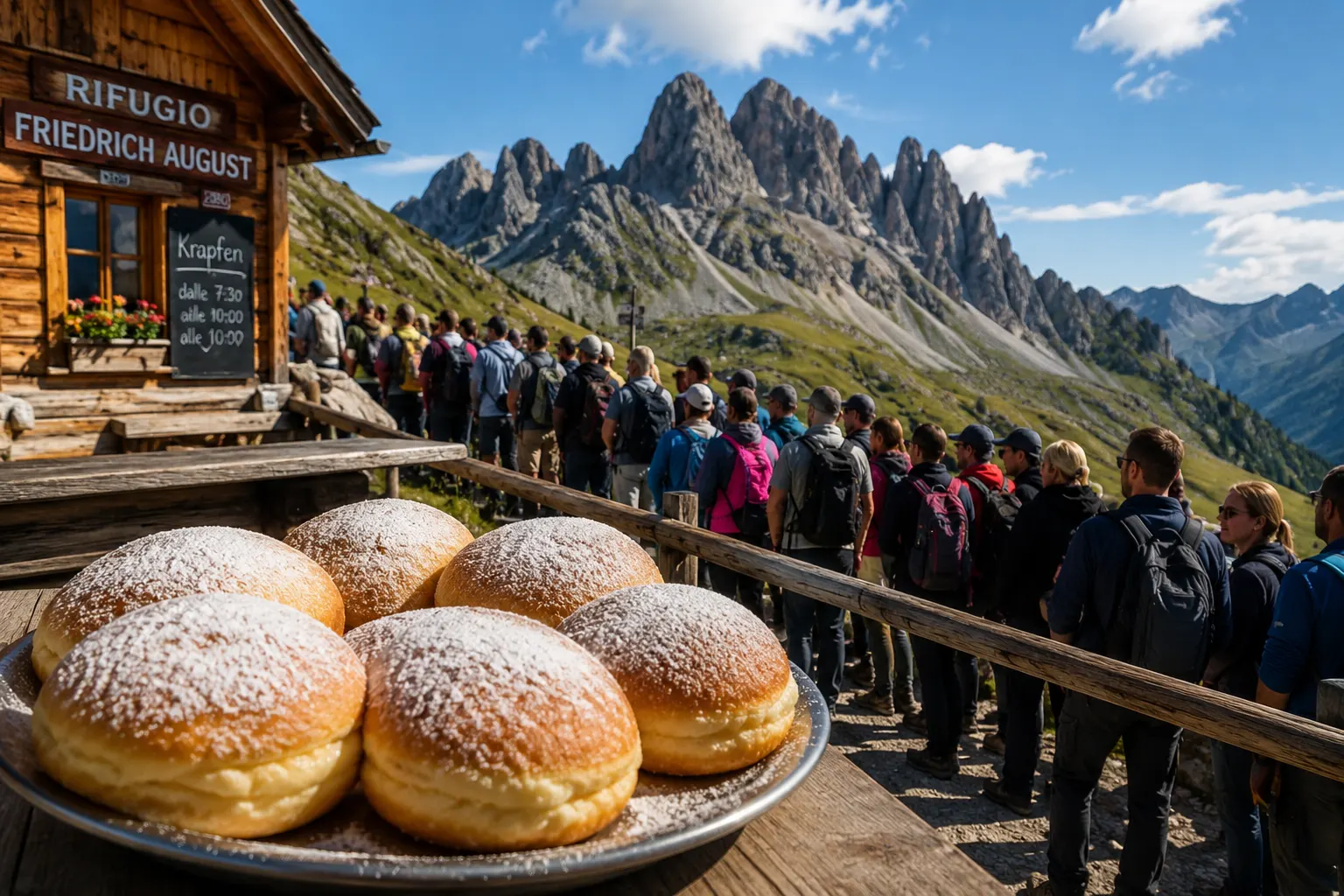
A €4 pastry, a mountain refuge and a very modern tourism problem
Imagine getting up before sunrise, heading into the Italian Dolomites and climbing towards a mountain refuge 2,300 metres above sea level.
Waiting at the top are spectacular views of some of Europe's most recognisable mountain scenery.
But for a growing number of visitors, there is another attraction.
A doughnut.
More specifically, a krapfen: a sweet filled pastry that has been served at the Friedrich August refuge in Val di Fassa for decades.
Thanks to social media, this relatively ordinary mountain tradition has become an unlikely tourist attraction in its own right.
Videos and photographs shared online have shown long queues of hikers waiting for the pastries, which cost around €3–€4. The vanilla-filled krapfen normally begin selling at around 7:30 in the morning and can be gone before 10am.
Some visitors have reportedly got up at dawn or stayed nearby overnight to improve their chances of getting one.
And suddenly a pastry that had quietly existed in the mountains for decades has found itself at the centre of a much bigger argument.
The krapfen didn't suddenly appear
There is an important detail that gets lost in the more dramatic versions of the story.
The Friedrich August refuge didn't invent a trendy product specifically for Instagram.
It has reportedly been making the pastries for around four decades.
What changed wasn't necessarily the food.
It was the audience.
Photographs and videos showing a freshly made pastry against the dramatic backdrop of the Dolomites began circulating online, creating exactly the kind of content that performs exceptionally well on platforms such as Instagram and TikTok.
Italian broadcaster Rai reported that social-media content involving the now-famous krapfen has accumulated tens of millions of views.
Once enough people see something like that, a strange transformation can occur.
A place stops simply being somewhere you can visit and becomes somewhere people feel they need to visit.
A pastry stops being something hikers happen to eat at a mountain refuge and becomes something people plan part of their holiday around.
But there's an important catch about those enormous queues
Images of long lines at the refuge have helped fuel the story, but they need some context.
Rai reported that one particularly long queue which circulated widely online was made significantly worse when the refuge experienced an internet connection problem.
At around 9am, according to a manager interviewed by the broadcaster, the system stopped working and the refuge was unable to process payments normally.
So it would be unfair to look at one photograph of an enormous queue and conclude that hundreds of people are standing there every morning solely because Instagram told them to buy a doughnut.
Nevertheless, the underlying phenomenon is real.
Social media is changing how people discover and experience the mountains.
And the krapfen has become an unusually visible example of it.
When Instagram chooses your holiday itinerary
For generations, people discovered destinations through guidebooks, travel agents, recommendations from friends and traditional media.
Today an algorithm can do it in seconds.
You scroll through your phone.
A video appears showing a beautiful mountain, beach, restaurant or village.
Millions of other people are shown the same thing.
A proportion save it.
A smaller proportion actually visit.
When the original audience numbers in the millions, even that small percentage can transform a location.
Rai reported that tourism officials in Val di Fassa have noticed a change in mountain visitors, particularly since the pandemic, including more tourists with little previous mountain experience and people staying for shorter periods.
Perhaps most tellingly, the local tourism organisation reportedly stopped collaborating with influencers and food bloggers two summers ago.
The problem facing some famous destinations is no longer simply:
“How do we persuade people to come here?”
Increasingly, it is:
“What happens when too many people want to come to exactly the same place?”
This isn't really about doughnuts
The Dolomites have experienced similar problems elsewhere.
Some extraordinarily photogenic locations have become social-media destinations where visitors arrive specifically to recreate photographs and videos they have already seen online.
In the municipality of Funes, access around the famous Santa Maddalena church has been restricted during part of the year after increasing numbers of visitors arrived along the narrow road.
Elsewhere, farmers near a popular trail in the Odle area installed a turnstile and charged visitors in protest at the pressure created by large numbers of tourists.
This is the strange contradiction at the heart of modern tourism.
For decades, destinations spent money advertising themselves.
Businesses wanted customers.
Tourism boards wanted visitors.
Hotels wanted bookings.
Restaurants wanted diners.
Then social media became arguably the most powerful tourism advertising system ever created — and in some places it worked almost too well.
So are influencers actually doing anything wrong?
This is where the argument becomes more complicated.
It is easy to blame influencers.
Someone with a huge following posts an idyllic video from a previously quiet location. Thousands of people save it. Other creators copy it. Soon everyone seems to be taking exactly the same photograph from exactly the same viewpoint.
From the perspective of residents and experienced mountain users, that can be enormously frustrating.
Paths become crowded.
Traffic increases.
Parking becomes difficult.
Natural areas experience greater pressure.
And places once associated with peace and isolation can begin to resemble outdoor attractions.
Critics argue that social-media tourism can reduce destinations to products: places to photograph, post and move on from.
There is a legitimate environmental argument there too. Mountain environments aren't theme parks designed to absorb unlimited visitor numbers.
But there is another side to this.
Nobody owns a beautiful place
Suppose someone from Britain has never heard of Val di Fassa.
One evening they see an Instagram video showing the Dolomites.
They think it looks incredible.
They save money, book a holiday, stay in a local hotel, eat in local restaurants and hike into the mountains.
Have they done anything wrong simply because Instagram introduced them to the destination?
Probably not.
And there can be something uncomfortable about experienced travellers complaining that a destination has become too popular only after they have already enjoyed it.
People have always followed recommendations.
The technology has changed, but the instinct hasn't.
A Lonely Planet recommendation could transform a backpacking destination.
A television programme could suddenly fill a village with visitors.
A newspaper restaurant review could create queues overnight.
TikTok and Instagram simply operate on a scale — and at a speed — previous forms of travel media could never achieve.
There is also the economic argument.
Visitors spend money.
Mountain refuges, hotels, restaurants, guides, transport operators and other local businesses depend on tourism.
For the Friedrich August refuge itself, selling thousands of pastries is not necessarily a bad business problem to have.
So perhaps blaming tourists for discovering somewhere popular misses the point.
Maybe the problem is that everyone is being shown the same places
This could be the more interesting issue.
Social media appears to offer unlimited choice, yet recommendation algorithms can sometimes create the opposite.
Millions of people are shown the same beach.
The same viewpoint.
The same restaurant.
The same mountain hut.
The same pastry.
Then everyone arrives wanting the same photograph.
Europe contains thousands of spectacular mountain trails, villages, beaches and towns that receive a fraction of the visitors seen at the handful of destinations dominating social media.
That raises an interesting possibility.
Perhaps the problem isn't that people travel too much.
Perhaps tourism is becoming too concentrated.
If social platforms can suddenly send enormous numbers of people towards one destination, perhaps tourism organisations should increasingly use the same technology to redirect visitors towards less crowded alternatives.
Instead of endlessly promoting places that are already famous, the next phase of European tourism marketing might actually involve encouraging people to spread out.
From hidden gem to viral attraction
There is another irony in the phrase “hidden gem”.
Social media is full of them.
Creators promise secret beaches, unknown restaurants, undiscovered villages and places “tourists don't know about”.
But once a video revealing a hidden gem receives several million views, there is an obvious problem.
It isn't hidden anymore.
The creator benefits because viewers love discovering somewhere that feels exclusive.
The audience benefits because they learn about somewhere new.
Local businesses may benefit from new customers.
But the location itself can lose exactly the characteristic that made the video appealing in the first place.
Quiet becomes crowded.
Unknown becomes famous.
Cheap becomes expensive.
Local becomes commercial.
And eventually another creator goes searching for the next hidden gem.
Tourism has always changed places
It is worth remembering that none of this began with TikTok.
Popular destinations have dealt with mass tourism for generations.
What social media changes is the speed.
A restaurant, beach or mountain viewpoint can go from relatively unknown internationally to globally recognisable remarkably quickly.
That gives destinations much less time to adapt infrastructure, transport, waste management and visitor controls.
And unlike traditional tourism advertising, nobody centrally decides which location an algorithm will make famous next.
Sometimes all it takes is the right photograph.
Or apparently, the right doughnut.
So who is responsible?
There probably isn't one simple answer.
Influencers can think more carefully about the effect of promoting environmentally sensitive locations.
Tourism authorities can stop advertising places already struggling with visitor numbers.
Platforms could potentially encourage broader destination discovery rather than endlessly amplifying the same viral locations.
Local authorities can manage access where overcrowding becomes genuinely damaging.
And tourists themselves can remember that discovering somewhere online doesn't mean experiencing it exactly as everybody else does.
You don't necessarily need the identical photograph.
You don't necessarily need to visit at the identical time.
And perhaps you don't always need to join the queue.
What do you think?
The viral Dolomites krapfen is funny on the surface.
People hiking up a mountain and queuing for a €4 pastry inevitably makes a good internet story.
But underneath it is a serious question about what tourism is becoming.
Is social media ruining Europe's hidden gems by sending enormous crowds towards places that were never designed for them?
Or is complaining about tourists who discovered somewhere through Instagram simply another form of gatekeeping?
After all, beautiful places aren't reserved for the people who discovered them first.
And local businesses are allowed to enjoy their success.
Perhaps the real challenge isn't stopping people from travelling.
It is finding a way for millions of people to discover Europe without millions of people being told to visit exactly the same places.
Which side are you on?
And one final question:
Would you get up at dawn and hike up a mountain for a €4 krapfen?
Sources & further reading
Rai News — Val di Fassa: viral krapfen and overtourism — Local reporting on the viral pastry, visitor numbers and the refuge's account of the unusually long queue.
Euronews Travel — Would you queue for a mountainside doughnut? — Reporting on the refuge, pastry and wider overtourism issues in the Dolomites.
The Guardian — Tourists on pastry quest overrun scenic spot in Italian mountains — Additional reporting on the tourism debate and reaction from Alpine organisations.

About the contributor
EuroCareFinder
Community Contributor
This contributor publishes information and discussion for the EuroCareFinder Community.